

Nominations open for IJ4EU Impact Award 2024

€15,000 in prizes for cross-border investigative journalism in Europe


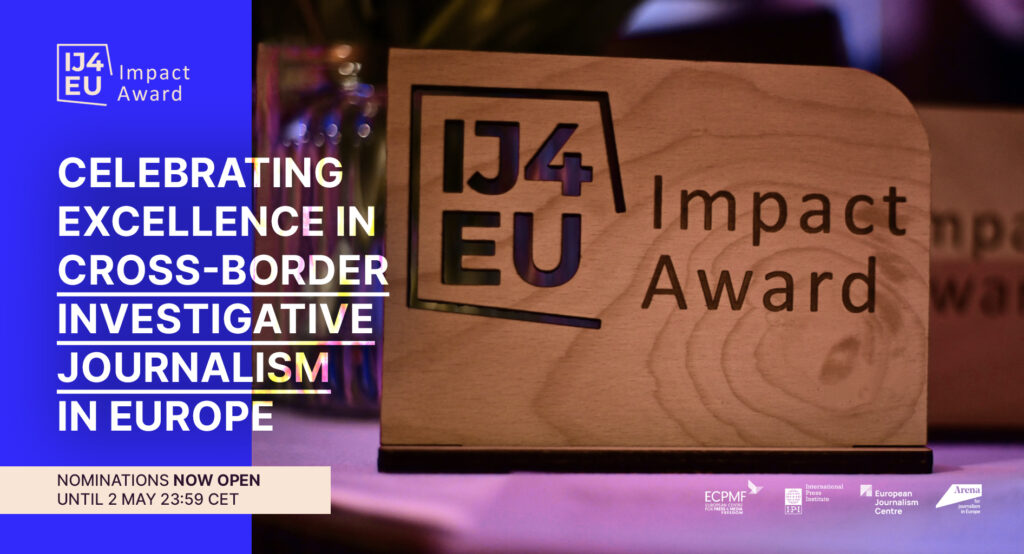
Nominations are open for the IJ4EU fund’s annual award celebrating excellence in European cross-border investigative journalism. Three cash prizes of €5,000 are available for investigative teams that have pushed the boundaries in tackling transnational stories of public interest.

Nominations opened on 7 March 2024 for the fourth annual IJ4EU Impact Award, run by the European Centre for Press and Media Freedom (ECPMF), one of four organisations implementing the IJ4EU programme.

The deadline for nominations is 2 May 2024 at 23:59 CET.

Winners

Winners will be announced at a ceremony organised by ECPMF at IJ4EU’s annual conference UNCOVERED, in September 2024.

The IJ4EU Impact Award honours the innovative use of cross-border journalism and its effectiveness in Europe.

Last year’s winners were The Devils Is in the Data, the Xinjiang Police Files, and Unmasking Europe’s Shadow Armies. The jury singled out a fourth investigation — Peat Pressure — for special commendation.

Support

The Impact Award is supported by the IJ4EU’s other implementing partners, the International Press Institute (IPI), the European Journalism Centre (EJC), and Arena for Journalism in Europe.


Eligibility

Any team meeting the eligibility criteria set out below can apply for the award, regardless of if they have received IJ4EU funding. Anyone is welcome to nominate investigative projects, including their own journalistic work, as long as the projects were published via a credible medium (e.g. print, broadcast television or radio, online, documentary film, multimedia etc.)  Investigations must have been published between 1 October 2022 and 31 December 2023.

The eligibility criteria are as follows:

  • The award is open to cross-border investigations published via any credible medium (e.g. print, broadcast television or radio, online, documentary film, multimedia etc.).
  • Nominated investigations must have been published between 1 October 2022 and 31 December 2023.
  • Nominated investigations must involve journalists based in at least two European countries that have signed up to the full cross-sectoral strand of the European Union’s Creative Europe Programme, which provides core funding for IJ4EU. Eligible countries include all 27 EU member states and the following non-EU countries: Albania, Bosnia and Herzegovina, Georgia, Iceland, Liechtenstein, Montenegro, North Macedonia, Norway, Serbia and Ukraine.
  • Nominated investigations need to highlight issues of common interest for European countries, and be seen to have strengthened European media.
  • Nominated investigations may have been published in any language. However, for investigations not published in English, a translation in English of the core investigation/summary must be provided.
  • Nominations must include any significant challenge to the honesty, accuracy or fairness of an entry, such as published letters, corrections, retractions as well as responses by the relevant newspaper or website.

A team of independent researchers will start to evaluate the impact of the nominated projects in spring. They will then be ranked according to:

  • Impact of the nominated investigation
  • Journalistic quality of the nominated investigation
  • Innovative use of cross-border journalism to cover a topic of public interest
  • Newsworthiness / added value of the nominated investigation to public discourse in the EU
  • Storytelling techniques

 During summer 2024, an independent jury set up by ECPMF will review the nominations (including a shortlist of the top 10) and select three cross-border investigations as winners. You can view last year’s jury here. Each award will be worth €5,000.


For more information, see the Awards page on the IJ4EU site and the relevant section in our frequently asked questions.

Read news by categories:

Related news

Statement

Czechia: Media freedom groups urge Czechia’s government to uphold public media’s independence

As Czechia’s new government prepares to reshape the funding and governance of its public broadcasters, press freedom groups caution that replacing the licence fee with state budget funding would expose ČT and ČRo to political pressure and weaken the editorial independence guaranteed under EU law.

READ MORE
Statement

Position Paper: Transnational Repression against Journalists in Exile

Transnational repression (TNR), the cross-border targeting, intimidation, and harassment of journalists and human rights defenders, is increasingly undermining press freedom and human rights in Europe and beyond. Journalists in exile often remain subjects of sustained threats, surveillance, cyber-attacks, psychological pressure, and harassment long after reaching presumed safety. These tactics are used by authoritarian states to silence dissent, extend their reach beyond borders, and weaken the role of independent media globally.

READ MORE
Statement

EU’s dangerous ‘Return Hubs’ policy: A threat to journalists in exile

The EU’s new “Return Hubs” migration policy endangers journalists and human rights defenders in exile by designating unsafe countries as “safe,” undermining press freedom and EU human rights commitments.

READ MORE
Statement

Open letter to Croatian Prime Minister Plenković: MFRR raises alarm over unlawful political pressure against weekly Novosti

Media Freedom Rapid Response (MFRR) consortium, expresses grave concern regarding recent statements by the Homeland Movement that targeted the weekly newspaper Novosti, the only print media for the Serb minority in Croatia.

READ MORE
Statement

Lithuania: Media freedom groups raise alarm as political pressure campaign on LRT widens

READ MORE
Statement

Ukraine: Peace plan must ensure accountability for crimes against journalists

As negotiations continue over a peace plan to end the Russian war on Ukraine, Media Freedom Rapid Response (MFRR) and partner organisations strongly oppose any proposals on granting amnesty for potential war crimes committed in the course of Russia’s full-scale invasion, especially for those against journalists.

READ MORE
Tags :