


The partners from the MFRR consortium today publish the latest edition of its Monitoring Report which documents press freedom violations from January to December 2023.


The latest Monitoring Report – produced by the European Centre for Press and Media Freedom (ECPMF), the International Press Institute (IPI), and the European Federation of Journalists (EFJ) as part of the MFRR – gathers and analyses all media freedom violations recorded on Mapping Media Freedom throughout the year 2023. 


War in Ukraine

The 2023 report opens with a thematic chapter on the ongoing war in Ukraine and its repercussions for press freedom. The MFRR recorded a total of 149 alerts throughout 2023 affecting 220 different media entities.


DDoS Attacks

Distributed Denial of Service (DDoS) attacks became prominent in Hungary and other countries in Europe. Unfortunately, the number of such cases doubled compared to the previous year, with 61 alerts targeting 112 persons or entities related to the media.


Incidents by public authorities/politicians

A third thematic chapter was dedicated to populist attacks on media freedom in Europe, ranging from verbal harassment and censorship, to legal attacks and ‘foreign agent’ laws. 


Abusive lawsuits and SLAPPs

A final thematic chapter focuses on civil and criminal lawsuits against journalists and media outlets. In 2023, 20 legal cases containing hallmarks of SLAPPs were recorded by MFRR partners.


The report also includes country reports offering a summary of the most relevant threats in the following EU countries: France, the Netherlands, Italy, Hungary, Spain, Finland, and Slovakia; and in the following candidate countries: Serbia, Albania, Bosnia and Herzegovina, and Turkey.


Key Figures

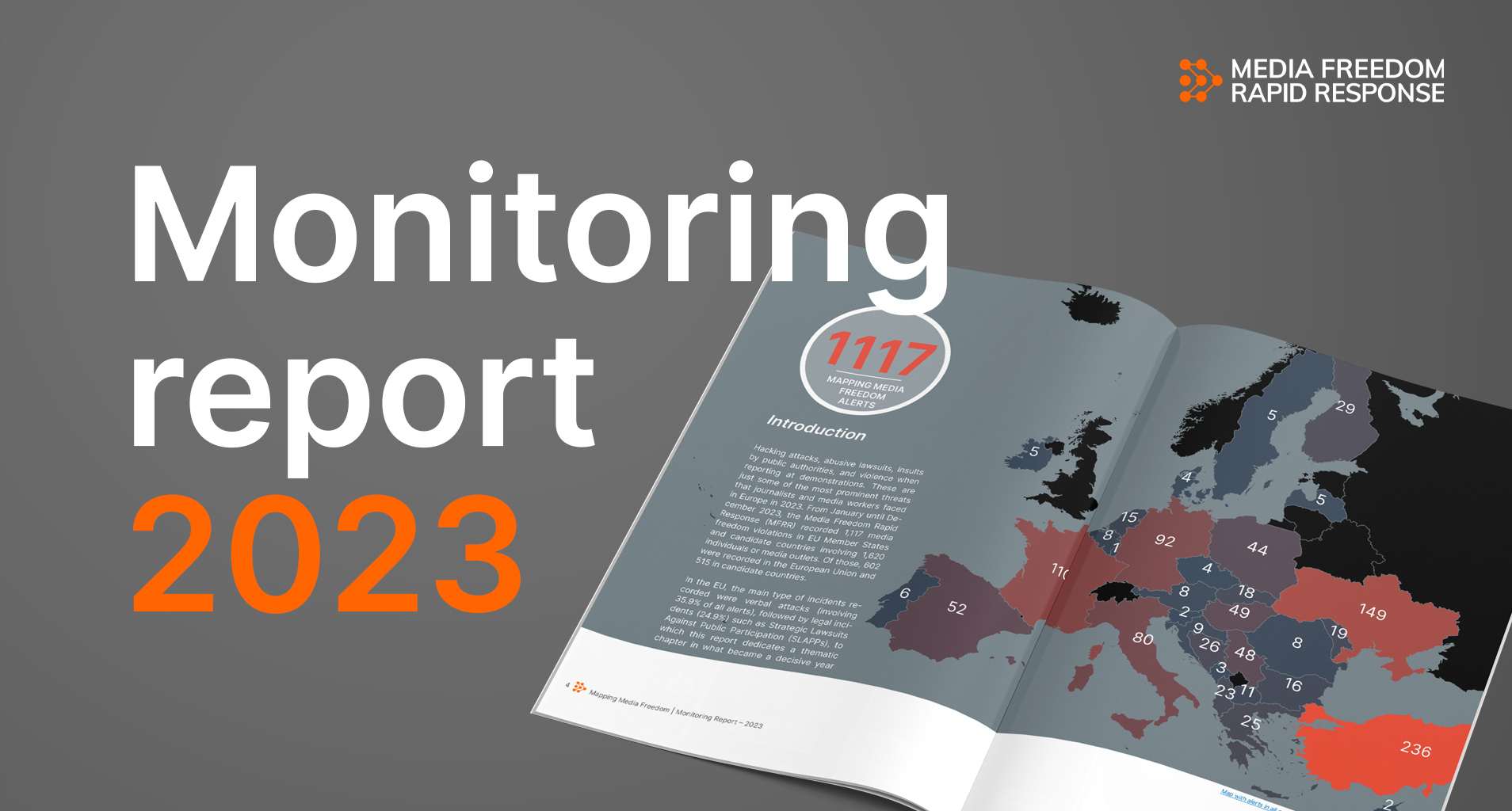
  • 1,117 media freedom violations were recorded in EU Member States and candidate countries, involving 1,620 individuals or media outlets.
  • 602 alerts were recorded in the EU, while 515 were registered in candidate countries.
  • In the EU, the main source of attacks remained private individuals (almost 33% of cases), worryingly followed by public officials (17.9%) and police and state security (12.6%).
  • 3 media workers were murdered – two in Ukraine and one in Albania.
  • 149 media freedom violations were recorded in Ukraine, a slight increase on last year’s 147 alerts. The MFRR started monitoring Ukraine immediately after the full-scale invasion in 2022.
  • 20.6% of all incidents in the EU involved some kind of physical attack. A considerable number of incidents included cases involving attacks to property (17.4%) and censorship (15.9%).
  • Within Member States of the EU, verbal attacks (35.9%) represented the largest amount of alerts, followed by legal incidents (24.9%) and physical attacks, accounting for 20.6% of the total incidents. In EU candidate countries, legal incidents were at the forefront of alerts (29.7%), followed by verbal attacks such as harassment second with 27.2%.

This Monitoring Report is part of the Media Freedom Rapid Response (MFRR), an Europe-wide mechanism, which tracks, monitors and responds to violations of press and media freedom in EU Member States and Candidate Countries. This project provides legal and practical support, public advocacy and information to protect journalists and media workers. The MFRR is organised by an consortium led by the European Centre for Press and Media Freedom (ECPMF) with ARTICLE 19, the European Federation of Journalists (EFJ), Free Press Unlimited (FPU), the Institute for Applied Informatics at the University of Leipzig (InfAI), International Press Institute (IPI) and CCI/Osservatorio Balcani e Caucaso Transeuropa (OBCT). The project is co-funded by the European Commission. www.mfrr.eu

We recorded 1117 media freedom violations on Mapping Media Freedom in 2023. Download the report below to learn more about each one – from country-specific analyses to thematic breakdowns.

Related news

Statement

Czechia: Media freedom groups urge Czechia’s government to uphold public media’s independence

As Czechia’s new government prepares to reshape the funding and governance of its public broadcasters, press freedom groups caution that replacing the licence fee with state budget funding would expose ČT and ČRo to political pressure and weaken the editorial independence guaranteed under EU law.

READ MORE
Statement

Position Paper: Transnational Repression against Journalists in Exile

Transnational repression (TNR), the cross-border targeting, intimidation, and harassment of journalists and human rights defenders, is increasingly undermining press freedom and human rights in Europe and beyond. Journalists in exile often remain subjects of sustained threats, surveillance, cyber-attacks, psychological pressure, and harassment long after reaching presumed safety. These tactics are used by authoritarian states to silence dissent, extend their reach beyond borders, and weaken the role of independent media globally.

READ MORE
Statement

EU’s dangerous ‘Return Hubs’ policy: A threat to journalists in exile

The EU’s new “Return Hubs” migration policy endangers journalists and human rights defenders in exile by designating unsafe countries as “safe,” undermining press freedom and EU human rights commitments.

READ MORE
Statement

Open letter to Croatian Prime Minister Plenković: MFRR raises alarm over unlawful political pressure against weekly Novosti

Media Freedom Rapid Response (MFRR) consortium, expresses grave concern regarding recent statements by the Homeland Movement that targeted the weekly newspaper Novosti, the only print media for the Serb minority in Croatia.

READ MORE
Statement

Lithuania: Media freedom groups raise alarm as political pressure campaign on LRT widens

READ MORE
Statement

Ukraine: Peace plan must ensure accountability for crimes against journalists

As negotiations continue over a peace plan to end the Russian war on Ukraine, Media Freedom Rapid Response (MFRR) and partner organisations strongly oppose any proposals on granting amnesty for potential war crimes committed in the course of Russia’s full-scale invasion, especially for those against journalists.

READ MORE