picture alliance / ZUMAPRESS.com | Suvra Kanti Das

A Bangladeshi journalist, forced into exile: “Staying alive to keep reporting is not a retreat from the profession. It is a condition of it.”

In an interview with ECPMF, a Bangladeshi journalist who was forced into exile because of his work spoke about his experiences: what it is like to work as a journalist in a country where press freedom is severely restricted, about the events that forced him into exile and also the psychological impact exile has on him. His experiences illustrate very clearly just how dangerous it is to be a journalist in Bangladesh. For this reason, we will not mention his name in the following in order to protect his privacy. 


By Leonie Hauck

Now being ranked 152nd out of 180 countries in the 2026 World Press Freedom Index, freedom of expression is severely restricted in Bangladesh. Reporters Without Borders mention Bangladeshi journalists being exposed to police violence, attacks by political activists and murders by Jihadist or criminal organisations. Can you describe what it is like to work as a journalist in a country where press freedom is that much restricted?

The ranking does not define the real scenario; the ground reality is worse. After more than three decades in national and international organisations and media outlets, I have learned that the hardest part is not finding information or drafting a story. For a reporter, a writer or an editor, danger often begins only after the story appears. Secret agencies may block access, seize equipment or delete photographs, mobs or angry crowds may attack the journalist directly, threats follow by phone or on social media and in the most serious cases, criminal actors have killed journalists.


This is not simply my personal impression. According to the Human Rights Support Society (HRSS), 383 journalists were subjected to harassment, attacks or intimidation between January and June 2026, a 32% rise in incidents compared with the same period in 2025. 15 cases filed against 33 journalists under the Cyber Security Act.


A journalist working at district or upazila (sub-district) level does not have the safety that a large newsroom in Dhaka can sometimes offer. Data from July 2026 show that 91% of recorded incidents of journalist abuse occurred at district and upazila level.


Those statistics record the journalists who were attacked, not those who decided not to write or investigate a story at all, not the source who became too frightened to speak, not the editor who quietly removed a story before publication because they anticipated a threat, an attack or a legal case.

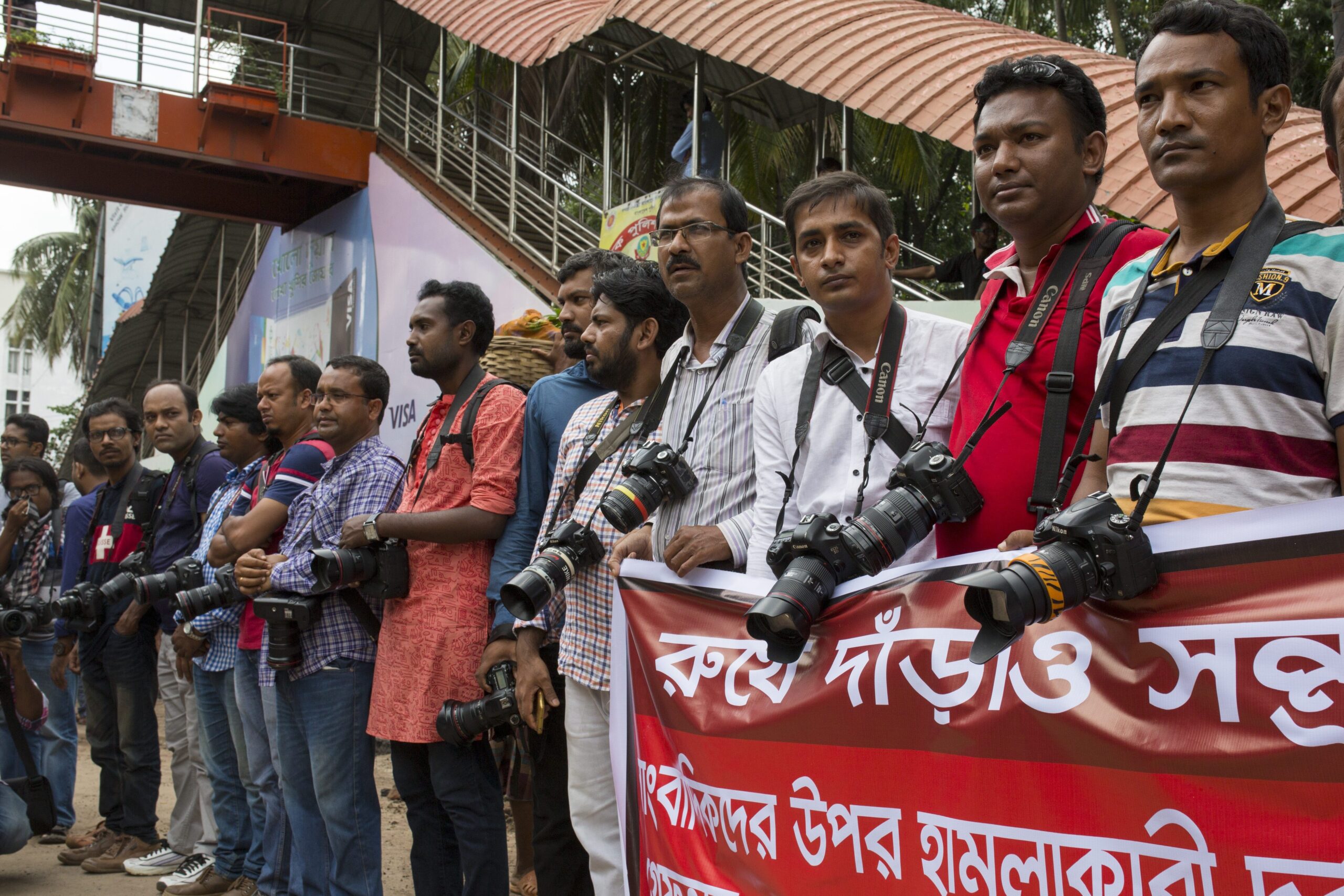
Bangladeshi photojournalists and journalists form a human chain in front of National Press Club protesting the attacks on them during the students’ protest in Dhaka , Bangladesh, August 2018. picture alliance / NurPhoto | Zakir Hossain Chowdhury

The legal environment adds another coat. Bangladesh’s Constitution guarantees freedom of speech and of the press under Article 39, subject to restrictions covering state security, public order, morality, contempt of court and defamation. Such restrictions are not unusual in themselves; what matters is how the laws are actually used. I am not arguing that Bangladesh should have no cyber rule, cybercrime is real, and states have a legitimate responsibility to address it. But journalists need a clear, reliable boundary between genuine cybercrime and legitimate journalism, criticism or public-interest expression.


The problem is now as digital as it is physical. Journalists face hacking, surveillance, doxing and coordinated online abuse, and once a journalist is politically labelled online, harassment can move into the physical world very quickly. A working journalist here has to think about physical, legal and digital security all at once.


Do you have particular examples of challenges you faced?

Yes, unfortunately, I have faced several challenges. The most serious came in 2023 and eventually forced me into exile, but it was not an isolated occurrence. It came after years of professional pressure, questioning, surveillance and intimidation because of my writing, my publications and my work for freedom of expression.


Everything changed in 2023, in two stages, over less than a month. On 14 April, I was invited to a hotel in Dhaka for what I understood to be a meeting about a research project. When I arrived, several unknown men took my phone and forced me away from the hotel area. They accused me of supporting separatists, of meeting indigenous people in the Chittagong Hill Tracts, and of having contacts with foreigners and diplomats. They told me they had been watching me for years. Most importantly, they gave me what they described as a final warning, stop associating with people or organizations they considered anti-national or separatist, and advise me to withdraw from public and critical work altogether. I was explicitly warned not to tell anyone about the encounter.

I took that warning seriously. Discussed with trusted friends, including lawyers and officials of the security and military establishment, tried to find out who was responsible, but could not find out which agency or force was behind it. On 7 May, the day before everything escalated further, I met an Ambassador, who advised me to seek a visa and leave Bangladesh for my safety and security.


The very next day, 8 May 2023, I was abducted. I consider it the worst experience of my life. For the next two or three days I was almost completely cut off from the outside world, physically weak, frightened and unable to think normally. That experience changed my understanding of danger. After it, I understood the danger could become physical, and deadly.


The pressure has also continued in digital form. As a journalist and freedom-of-expression activist, I have faced social-media harassment, defamatory content, hostile online campaigns and attempts to damage my professional reputation, and I have real concerns about surveillance and doxing.


The trauma has not disappeared because I left Bangladesh. I should say plainly that this is not a closed chapter. Nobody was ever identified, nobody was ever held to account, and no investigation was ever opened.

You also engaged as an activist back in Bangladesh. Can you go into detail about that?

For me, journalism and activism were never two separate paths. I started my career in 1995, in a progressive socio-political periodical that dealt with people’s engagement and movements. From the beginning, I was not simply reporting on movements from the outside, but was part of the civic engagement.


By the late 1990s, my work had moved decisively toward grassroots journalism, and this is where most of my activism took concrete institutional form. Working across the coastal region of Bangladesh, I helped build the capacity of local and district-level journalists, usually with no contract, no legal backing and no institutional protection.


I set up a Rural Feature Service to bring stories out of communities that were largely invisible in national media, and I led Jonototthoghar, the People’s Information Centre, in remote areas. The idea was simple: information should flow in two directions. People at the margins should be producers of information, not only its subjects.


That principle led me into advocacy for the Right to Information Act, which Bangladesh adopted in 2009. I believed, and still believe, that access to information is not a technical or administrative matter. It is a precondition for citizenship.


After the so-called “Monsoon Revolution”, which ended the 15 year reign of Sheikh Hasina, Bangladesh had an interim government for 18 months. Since the parliamentary elections in February 2026 the Bangladesh Nationalist Party has been in charge. Looking at the political climate of your home country: What concerns do you have in regards to the future of independent journalism?

What worries me is not any single law or any single government. Bangladesh has recently been through three governments: Sheikh Hasina’s own Awami League administration, an eighteen-month interim government led by Muhammad Yunus, and now, since February 2026, the BNP government. That turbulence has produced a climate in which journalists are targeted.

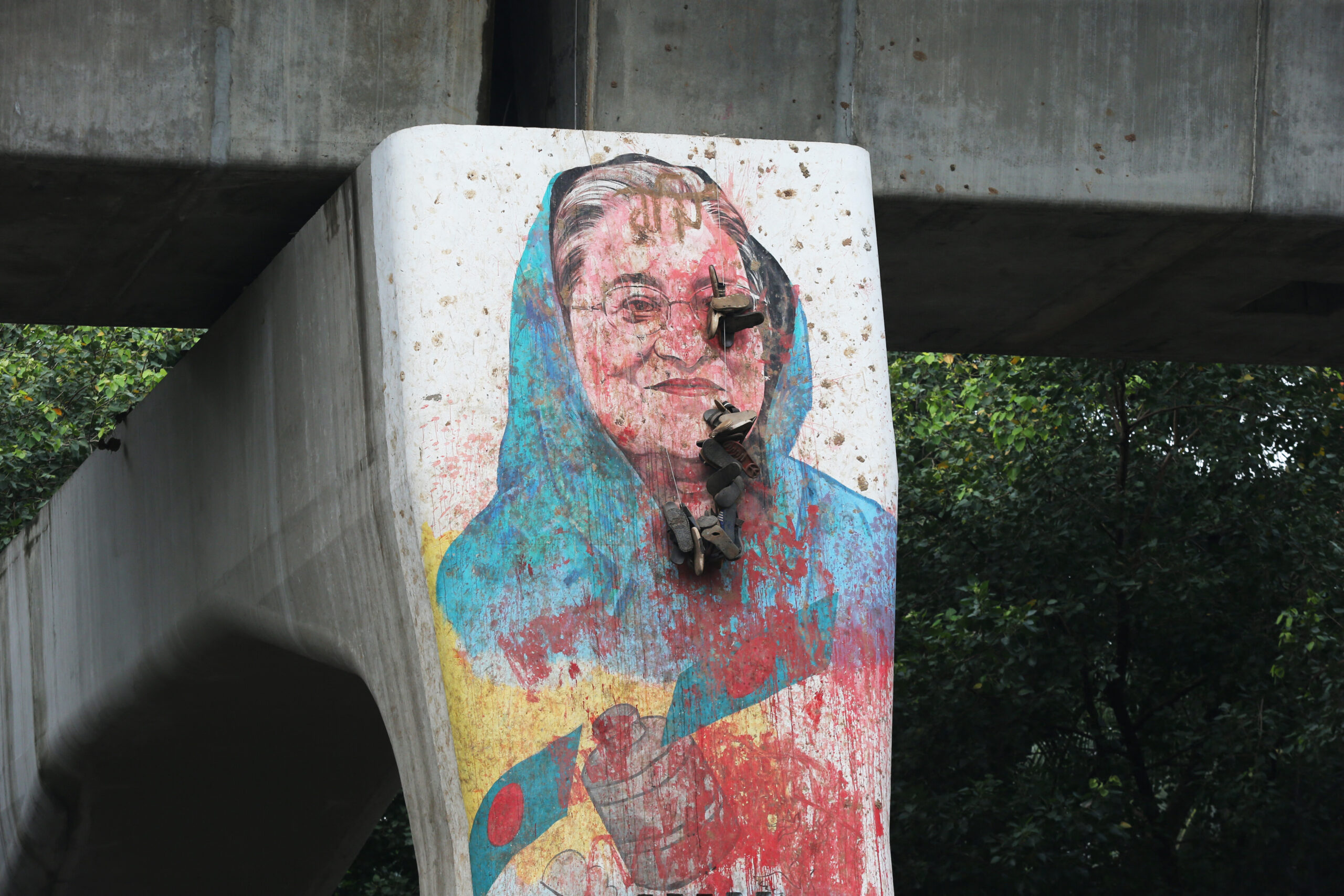
People damage a painted portrait of former prime minister Sheikh Hasina in Dhaka, Bangladesh, on 16 August 2024. picture alliance / abaca | Habibur Rahman/ABACA

The legal architecture keeps changing its name without changing its character, and this is the part that concerns me most as a long-term structural matter. So when I look at the present government specifically, it is about continuity. Independent journalism in Bangladesh has now survived an autocrat, a mass uprising and an interim government, and people hoped the machinery of repression would be dismantled. Instead, digital surveillance, physical violence, legal persecution, political vendettas, mob intimidation and extremist pressure keep converging into a climate of fear and self-censorship, a structural vulnerability that has outlasted every regime that built a piece of it. The real test for this government, and for whichever government comes after it, is whether that machinery gets taken apart for good, or simply changes hands again. As the IFJ put it in a joint statement with the Federation of Asia-Pacific Journalists and the South Asia Journalists Federation, there can be no resurrection of democracy in this country while journalists remain under threat.


You are very open in talking about struggling with depression. What part does having been forced into exile and separated from your family back in Bangladesh play in that regard?

Yes, I am open about this, because I think it can help anyone living with fear and frustration. Exile did not only take my home from me. It took my daughter and my wife, and that absence sits underneath everything else I deal with here, every single day.


The practical symptoms are real and specific. I have struggled with sleep, and there are days I simply cannot write at all, which is strange and painful to admit for someone who has spent more than thirty years writing. I have experienced memory breaks that unsettle me, and panic attacks that arrive with very little warning, often at the quietest moments.


There was a brief period, in August 2024, when I let myself hope, when Sheikh Hasina’s government fell and part of me thought I might finally go home. That hope did not survive long, and having it taken back was its own kind of loss.


What remains hardest, even now, is the isolation. Therapy has given me real tools, but no session fully answers the simple fact of not being able to hold my daughter or my wife when I need to. I have decided that carrying this honestly, in public, is better than hiding it. Our profession has a culture of endurance, you are supposed to absorb what you witness and keep filing. That culture has a cost, and I think it is time people in this field said so plainly.


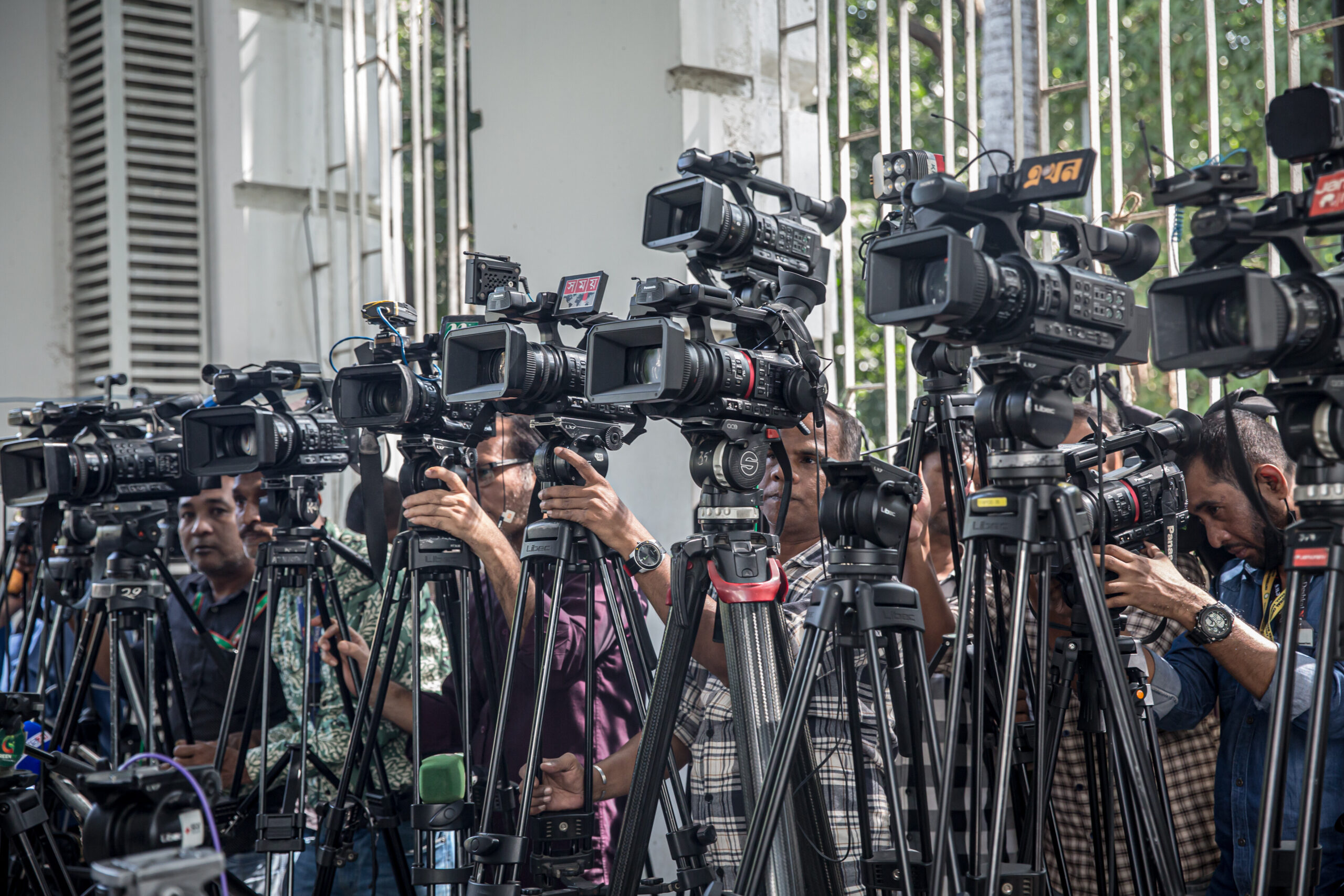
Journalists gather outside Bangladesh’s International Crimes Tribunal in Dhaka on 18 November 2025, ahead of the verdict against ousted prime minister Sheikh Hasina, who fled the country in August 2024 following a deadly crackdown on protests. picture alliance / ZUMAPRESS.com | Sally Hayden

Do you have helpful advice for other journalists who are forced into exile?

Exile is a challenge in itself. Try to engage yourself. Stay with journalist networks and continue to produce your own work, even an article, a research paper or a radio script keeps a journalist active and prevents dislocation from one’s whole identity. Build relationships with press-freedom and digital-rights organisations before you need emergency help, not only after. When I needed help in 2023, the organisations that responded (Free Press Unlimited, CPJ, Article 19, Front Line Defenders, and later ifa) were reachable partly because journalism has built those channels over decades.


Take the digital threats seriously from the first day, not after something happens. Exile does not necessarily end surveillance or online harassment, in some cases it intensifies, sometimes onto family members who are still at home. Expect the emotional cost to be real, and not to disappear on any fixed schedule. Seek psychological support early and treat it as a professional necessity, not as a personal weakness.


Journalist organisation desks should document journalists’ suicides, suicide attempts, silent psychological breakdowns and occupational stress, which otherwise remain largely invisible in international press-freedom assessments. Support institutions should establish an independent, confidential, profession-specific monitoring mechanism, while carefully distinguishing verified facts from allegations.


There is one further thing I want to say, because it goes beyond individual advice and speaks to what our institutions owe us. Leaving a country is not a betrayal of the work. A journalist can continue working from elsewhere; it may change shape, but it continues. Staying alive to keep reporting is not a retreat from the profession. It is a condition of it.

Read news by categories:

Related news

Statement

Hungary: International coalition to hold fact-finding mission amid media reforms

Press freedom groups to visit Budapest six months into new Tisza government: From November 4 to 6, 2026, a coalition of international media freedom and journalist organisations will travel to Hungary to learn about the ongoing media reform under the Tisza government and provide expert recommendations for rebuilding press freedom after years of backsliding.

READ MORE
Statement

Serbia, Europe is watching: media freedom is a cornerstone of democratic elections.

The undersigned partners of the Media Freedom Rapid Response (MFRR) and Safe Journalists Network (SJN) ahead of the parliamentary elections on 25 October are alarmed by the spiral of violence against journalists and by the overall situation surrounding media freedom.

READ MORE
Statement

ECPMF condemns violent attacks against journalists in Albania

ECPMF is alarmed by the attacks against journalists during the recent protests in Albania and condemns all acts of violence and obstruction targeting media professionals.

READ MORE
Statement

Being a queer journalist in Russia: “We keep going despite everything”

Russian journalist Vadim Vaganov speaks to ECPMF about LGBTQ+ persecution, censorship, press freedom and life in exile.

READ MORE
Statement

Malta: Press freedom groups lament another year passing without full justice for Daphne Caruana Galizia murder

On the ninth anniversary of the murder of Maltese investigative journalist Daphne Caruana Galizia, the undersigned international media freedom and journalist groups today lament that full justice for the car bomb assassination remains painfully elusive.

READ MORE
Statement

Turkey: Trustee appointment at Halk TV must be reversed

The ECPMF and 12 press freedom, freedom of expression, and human rights organisations call on the Turkish authorities to immediately end the takeover of Halk TV’s management and restore the broadcaster’s editorial independence. A criminal investigation into the channel’s owner cannot justify seizing control of a newsroom and silencing its coverage.

READ MORE