The European Centre for Press and Media Freedom (ECPMF) is a non-profit organisation that was founded in Leipzig, Germany, 2015. It operates on the basis of the European Charter on Freedom of the Press and the Charter of Fundamental Rights of the European Union.
The vision of the Centre is a society where media freedom enables open discourse and everyone can seek, receive and impart information.
ECPMF’s mission is to promote, preserve and defend media freedom. We do this by monitoring violations, providing practical support and engaging diverse stakeholders across Europe.
The history of ECPMF can be told in four steps:
History
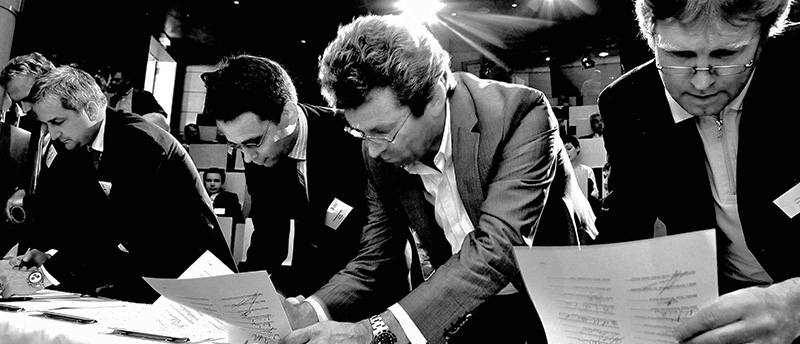
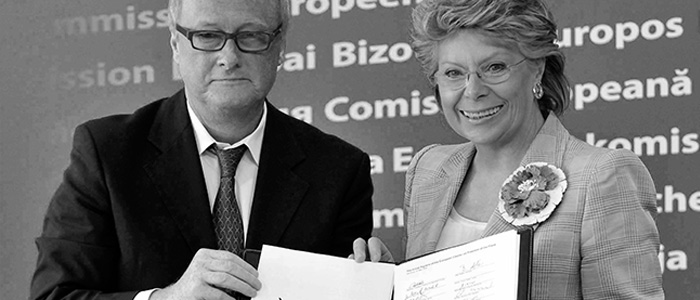
In 2009, Hans-Ulrich Jörges, then a member of the editorial board of stern magazine, initiated the European Charter on Freedom of the Press. In ten articles, it defines what is required to protect a democratic public sphere. The Charter was signed by 48 editors-in-chief and leading journalists from across Europe. Its text and signatories were published in several languages at www.pressfreedom.eu, and the signed documents were handed over to the European Commission in Brussels and to the Council of Europe. The aim was to establish the Charter’s validity across Europe and to make its adoption a precondition in EU accession negotiations.
To make the Charter effective, its initiators sought to create an independent watchdog institution. In 2010, the Media Foundation of Sparkasse Leipzig took up this idea together with Hans-Ulrich Jörges. Over several years, the Foundation developed the concept, provided startup funding and steered the creation of the new organisation. In the European Parliament, a cross-party alliance backed the initiative, including Martin Schulz (Socialists and Democrats), Elmar Brok (European People’s Party), Alexander Graf Lambsdorff (ALDE, the Liberal group) and Helga Trüpel (Greens/European Free Alliance). Leipzig was chosen as the location because the Peaceful Revolution that brought down the GDR regime began here in 1989.
In June 2015, the European Centre for Press and Media Freedom began its work in Leipzig as a project of the Media Foundation of Sparkasse Leipzig, which had developed the Centre. Its initial financing came from the European Commission, the Free State of Saxony, the City of Leipzig and the Media Foundation.
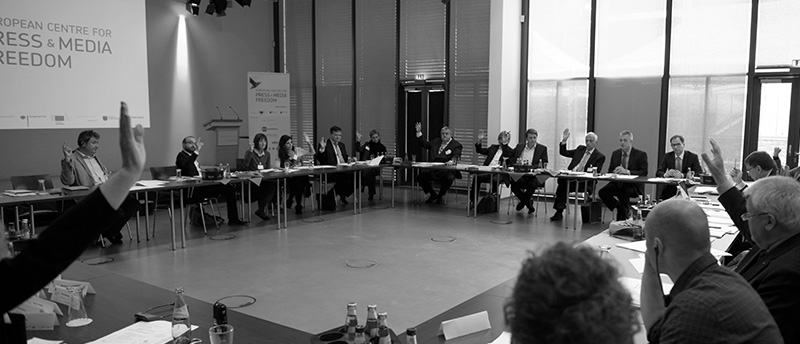
In 2017, supporters from across Europe founded the ECPMF as a European Cooperative Society (SCE), the legal form proposed by the Media Foundation. They included journalists, publishers, media lawyers, academics, trade unions, investigative journalism organisations, media industry leaders, and campaigning and aid organisations. The Foundation remains closely connected to the Centre. It continues to contribute to the ECPMF’s long-term stability through its Management Board, and the ECPMF is still based at the Foundation’s headquarters, the Mediencampus Villa Ida in Leipzig.
Since its founding, the ECPMF has monitored violations of press freedom across Europe, provided legal support, developed protection programmes for threatened media workers and promoted professional exchange through workshops and studies. Today, the European Commission is its main funder. The Cooperative has 39 members and around a dozen staff. The Centre is part of a pan-European network of freedom of expression organisations, and together they carry out major projects such as the Media Freedom Rapid Response (MFRR) and the IJ4EU grant programme. As part of the Hannah Arendt Initiative, the ECPMF supports threatened journalists in Ukraine and in exile.